Table of Contents
In May 2026, one comment from a Supreme Court judge lit a fire across India. Chief Justice Surya Kant, during a routine court hearing, made a remark that many heard as comparing unemployed young Indians to cockroaches. Within hours, the internet exploded. Within days, a satirical movement called the Cockroach Janta Party (CJP) had gathered more Instagram followers than India’s two biggest political parties combined. What started as a meme had become a movement. This is the story of how India’s Gen Z used humor, rage, and social media to send a message to the country’s political establishment and why the world should be paying close attention.
The Comment That Sparked India’s Gen Z Protest Movement
On May 15, 2026, Chief Justice Surya Kant was presiding over a hearing when he said:
“There are youngsters like cockroaches, they don’t get any employment, they don’t have any place in profession.”
The remarks were aimed, he later clarified, at people who obtain professional degrees through fraud. But that clarification came too late, and for many young Indians, it rang hollow.
As we know that India is home to the world’s largest youth population. Millions of young people graduate every year and step into a job market that simply cannot absorb them. Youth unemployment in India has remained stubbornly high for years. Inflation has eaten into household savings. Competition for government jobs is fierce to the point of being nearly impossible. When a senior judge of the nation’s highest court appeared to call these struggling young people “cockroaches,” the reaction was not just anger but it was a breaking point.
Social media feeds across Instagram, X, and WhatsApp flooded with reactions. Hashtags trended. Memes spread like wildfire. And then one person decided to do something more.
Who Created the Cockroach Janta Party? Meet Abhijeet Dipke
Abhijeet Dipke is a 30-year-old political communications strategist. A Boston University graduate who previously worked with the Aam Aadmi Party (AAP), he was scrolling through the online outrage when a simple thought crossed his mind:
“What if all cockroaches come together?”
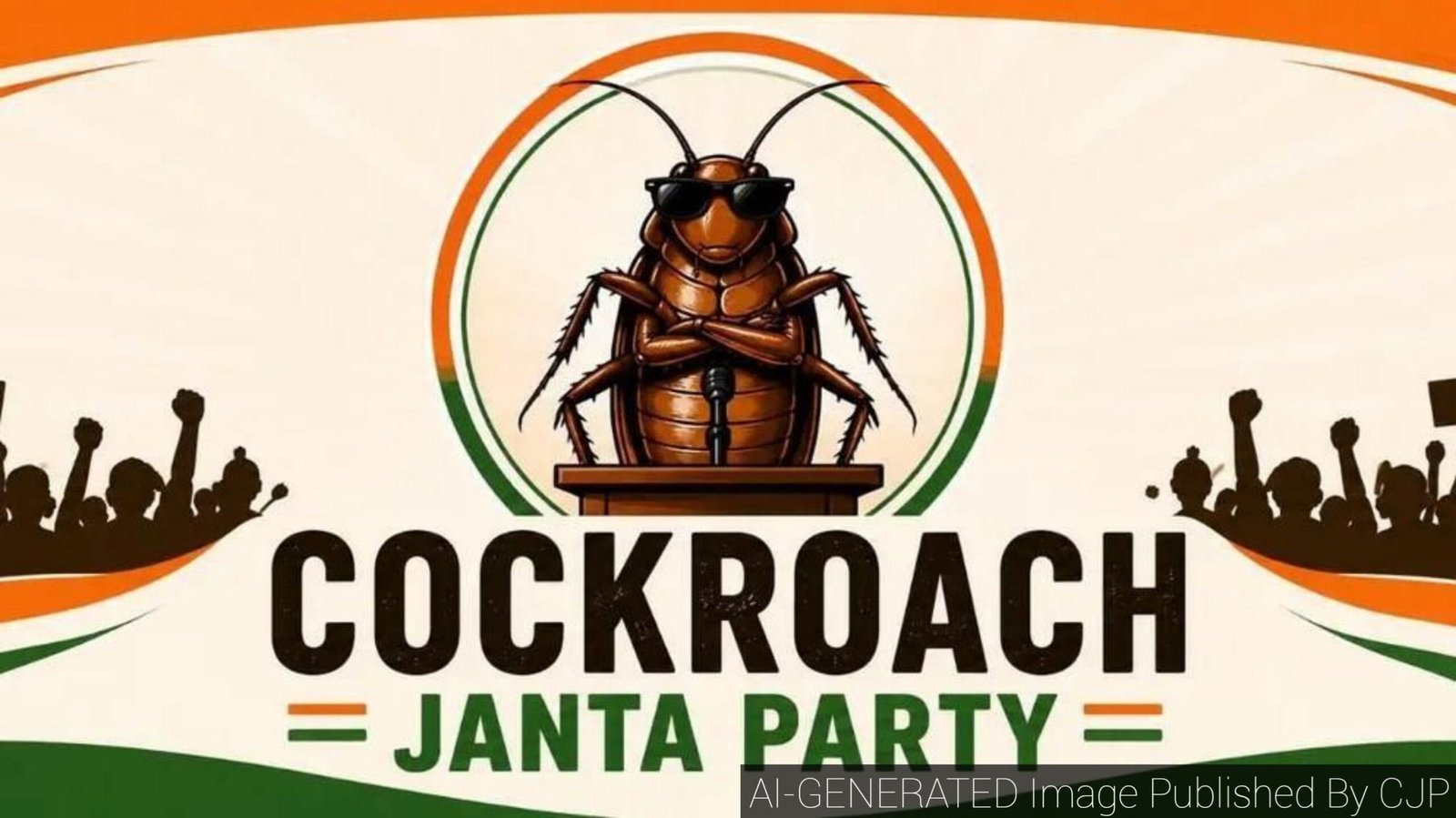
He posted that question on X on May 16, 2026, the day after the judge’s remarks. Then he went further. He registered a website and set up social media accounts for a fake political party: the Cockroach Janta Party. The name was a deliberate parody of the ruling Bharatiya Janata Party (BJP), replacing “Bharat” with “Cockroach.” The message was clear: if those in power see citizens as cockroaches, then the cockroaches would organize.
“Those in power think citizens are cockroaches and parasites,” Dipke told Al Jazeera from Chicago, where he was based. “We decided to own that label.”
The response was beyond anything he had imagined. He barely slept for three days as followers poured in by the millions.
20 Million Followers Overnight: The Power of Gen Z Viral Protest on Social Media
The CJP’s Instagram account crossed 19 million followers in less than a week, nearly double the follower count of the Indian government’s official account. By the end of the second week, the number had crossed 20 million. AI-generated images of a cartoon cockroach mascot appeared across news channels, newspapers, and social feeds. The movement had gone from a joke to a national headline.
What made this spread so fast? Three things. First, the emotion was real. Young Indians, overeducated, underemployed, and tired who finally had a symbol they could rally behind without it feeling preachy or partisan. Second, the format was perfect for the internet. Self-deprecating humor, relatable memes, and a clear villain (the establishment) made sharing feel natural. Third, the name itself was brilliant. It flipped the insult, transforming a derogatory label into a badge of pride.
Students, fresh graduates, young professionals, and even school-aged teens shared the CJP logo on their profiles.
Youth Unemployment in India 2026: The Real Fuel Behind the Movement
The CJP is funny on the surface. But beneath the memes is a generation dealing with very serious problems. India’s youth unemployment rate has hovered at distressing levels for years. Millions of young graduates enter the workforce annually, but the economy has not created enough quality jobs to absorb them. Many are overqualified for the work available and underpaid when they do find it. Engineering graduates drive taxis. MBAs work in call centers.
Add to this a political environment that many young people describe as dominated by religious nationalism, corruption, and indifference to economic reality, and you have a generation sitting on a powder keg. The CJP gave that frustration a voice. Or rather, a mascot.

It is worth noting that India’s Gen Z has grown up entirely in the era of social media. They do not process politics the way older generations do. They speak in memes. They organize online first. They distrust traditional media and political parties equally. The CJP understood this instinctively, and that is why it connected so fast.
Government Crackdown: X Account Withheld, Hacking Allegations, Death Threats
The movement’s rapid rise did not go unnoticed by the establishment. Within five days of the CJP’s creation, its account on X was withheld, meaning it was made unavailable to users in India. The action was widely seen as politically motivated, though no official reason was publicly given.
Dipke claimed that both the CJP parody account and his personal Instagram handle were hacked. More alarmingly, he alleged that he and members of his family had received death threats online. He was forced to address these threats publicly while continuing to manage a movement that had grown far beyond anything he originally planned.
Meanwhile, the ruling BJP launched what analysts described as a coordinated counter-narrative. Party spokespersons dismissed the CJP as a collection of “anti-institutional agitators” and attempted to reframe the conversation around the government’s development record. But for millions of young Indians who had already joined the movement, the dismissal only added fuel to the fire.
Dipke took care to distance the CJP from comparisons to violent Gen Z uprisings in neighboring Nepal and Bangladesh, where youth protests had toppled governments. He repeatedly stated that the CJP would remain a peaceful movement operating within the boundaries of India’s Constitution.
Is This Just a Meme Or the Beginning of India’s Gen Z Political Uprising?
That is the question every political analyst in India is now asking. And the signals are worth watching carefully.
The CJP is not a registered party. It cannot contest elections. It has no manifesto, no candidates, and no formal organizational structure. But movements do not need any of those things to shift political landscapes, at least, not at first.
Bangladesh’s Gen Z revolution in 2024, which forced Prime Minister Sheikh Hasina to flee the country, did not begin as an organized political force either. It began as student protests then spread through social media, that grew until they were impossible to contain. Nepal saw similar youth-driven unrest in 2025. In both cases, the establishment underestimated the anger until it was too late.
India’s situation has some important differences. The country’s democracy is older, its institutions are more deeply entrenched, and its population is far larger and more diverse. A national uprising of the kind seen in Bangladesh is not a simple copy-paste scenario. But the CJP has demonstrated something that cannot be easily dismissed: India’s Gen Z is politically aware, digitally organized, and deeply frustrated. That combination has historically been a precursor to something bigger.
The authentic rage fueling the CJP is a volatile political asset. As one analysis put it, this is a generation of “overeducated, underemployed, and digitally atomised youth” who have found each other online and are beginning to see themselves as a collective force. Whether the CJP remains a pressure valve, releasing steam harmlessly, or becomes a spark for something more organized depends on what happens next.
Watch for two things. First, whether the CJP attempts to formalize, creating chapters, demands, or street-level organizing. Second, whether India’s upcoming state elections in late 2026 and early 2027 see any CJP-linked mobilization, either as a spoiler or as a youth voting bloc. Either development would signal a significant shift in Indian politics.
What the Cockroach Janta Party Tells Us About the Future of Political Protest
Regardless of what happens next, the CJP has already made history. It is one of the fastest-growing satirical political movements in the world, built in days with no budget, no party machinery, and no television coverage, just a meme and a moment.
It shows that in 2026, political power is not only about who controls the parliament. It is also about who controls the narrative online. India’s Gen Z has demonstrated that they can organize, amplify, and dominate a national conversation in ways that no traditional political party fully understands yet.
The cockroach, one of nature’s most resilient creatures, has become a fitting symbol for a generation that has been overlooked, underestimated, insulted, and has decided to fight back on its own terms. Whether India’s political establishment takes that seriously, or continues to swat at it, will say a great deal about the country’s next decade.
One thing is certain: the cockroaches are not going away.
Author:
Charles Henry