Table of Contents
Saudi Arabia, Pakistan and Turkey have formally activated the Mecca Defence Pact, agreeing to deploy military forces and capabilities to the kingdom after a sharp rise in attacks from Yemen. The decision, announced on Monday, October 5, 2026, is the first real test of a three-way security alliance that has existed on paper for only a few weeks. This article explains what was decided, what the pact is, and what remains unclear.
Mecca Pact Activated: What Happened in Riyadh on October 5
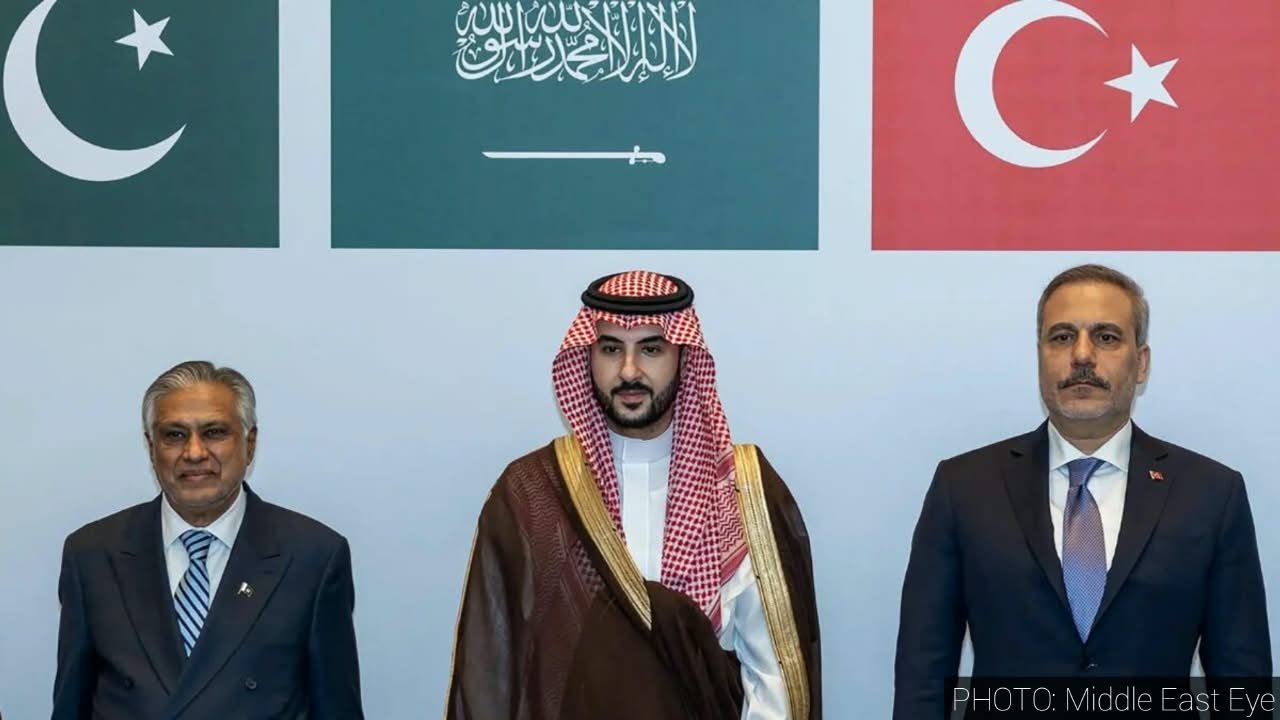
Representatives of the three countries held an emergency meeting of the alliance’s Strategic Political and Defence Committee in Riyadh. Pakistan was represented by Deputy Prime Minister and Foreign Minister Ishaq Dar, Saudi Arabia by Defence Minister Prince Khalid bin Salman, and Turkey by Foreign Minister Hakan Fidan.
The meeting noted recent attacks on Saudi Arabia, in particular those targeting the holy cities of Mecca and Medina. The statements released did not name the Houthis directly, although media coverage links the attacks to the Iran-backed group in Yemen.
Prince Khalid bin Salman said the committee had agreed to activate collective deterrence measures within the alliance’s framework in response to the attacks and those responsible. A separate joint statement published by Pakistan’s Foreign Ministry said the three countries would provide the agreed military forces and capabilities and ensure their rapid deployment to Saudi Arabia. Turkey and Pakistan described this as a “rapid deployment” of troops.
What Is the Mecca Defence Pact?
The Mecca Joint Defence Agreement was signed by the three countries in August. Its core commitment is mutual assistance: if one member is attacked, the others come to its aid. Saudi Arabia is the kingdom hosting Islam’s two holiest cities, Pakistan is a nuclear-armed state with a large standing army, and Turkey is a NATO member with a developed defence industry, including advanced drone production.
The agreement was signed shortly before the Houthis launched their latest offensive in Yemen, which has included attacks on Saudi targets. Until this week, its activation had been a hypothetical.
Pakistan-Saudi Arabia Defence Pact: The Foundation
The Mecca Defence Pact builds on an earlier bilateral deal. On September 17, 2025, Saudi Crown Prince Mohammed bin Salman and Pakistani Prime Minister Shehbaz Sharif signed the Strategic Mutual Defence Agreement in Riyadh. It defines an attack on either country as an attack on both. The signing came a week after Israel’s strike on Qatar.
The relationship is much older. Pakistani troops first travelled to Saudi Arabia in the late 1960s, when Egypt’s involvement in the war in Yemen raised concerns in the kingdom. When the 2025 pact was announced, neither government answered questions on whether it extended to Pakistan’s nuclear arsenal, and India said it would study the implications for its own security.
Reports in early 2026 said Turkey was in advanced talks to join the arrangement, viewing it partly as a hedge amid doubts over the reliability of US security guarantees. Those reports were based on unnamed sources, and the August agreement is the formal outcome.
Houthi Attacks on Saudi Arabia: The Trigger
The Houthis have fought in Yemen for 12 years and have taken large areas of the country. After they fired a barrage of missiles toward Saudi Arabia in early September, Pakistan’s Defence Minister Khawaja Asif said an attack on the kingdom could set the pact in motion.
The latest escalation also includes attacks aimed at Mecca and Medina, which gives the alliance a politically powerful justification. At the same time, Yemeni government forces backed by Saudi Arabia have launched a large-scale offensive, with the stated aim of retaking all territory the Houthis have captured over the course of the war.
Will Pakistan and Türkiye Troops Fight the Houthis?
This is the key open question. Khawaja Asif said on Geo TV that Islamabad and Ankara already have a “presence in the theatre,” but that Saudi forces are currently the only troops engaged in combat operations. It remains unclear whether Pakistani and Turkish forces will take part directly in fighting.
One analysis of the announcement stresses that activation does not by itself put Turkish or Pakistani infantry on the front lines in Yemen. What it does is place foreign military capabilities inside Saudi territory, which strengthens deterrence and signals that the kingdom has regional backing. No official figures on troop numbers, units or timelines have been published so far.
Why the Mecca Pact Activation Matters for Regional Security
Analysts see several implications, though all are early assessments rather than settled facts.
- Houthi isolation: Middle East Eye reported that the move could deepen the Houthis’ isolation in the region.
- Regional legitimacy: By invoking the pact, Saudi Arabia underlines that it has the support of the wider region for its counter-offensive.
- Security impact: Abdulaziz Alghashian, a senior non-resident fellow at the Gulf International Forum, said the decision will have a major impact on regional security.
- Three very different militaries: The alliance combines Saudi financial resources, Pakistan’s large army and nuclear status, and Turkey’s combat-experienced forces and drone industry.
Open Questions to Watch
- How many troops and what equipment will Pakistan and Turkey send, and when will they arrive?
- Will either country take part in offensive operations in Yemen, or only defensive tasks inside Saudi Arabia?
- How will Iran, which backs the Houthis, respond to the deployment?
- How will the pact be received domestically in Pakistan and Turkey, where parliamentary and public debate over foreign deployments is likely?
Published By
The Khilafat Times